Wednesday, May 24, 2006

Talking money, too.

Someone had to ask it. The where’s-the-money question, that is.

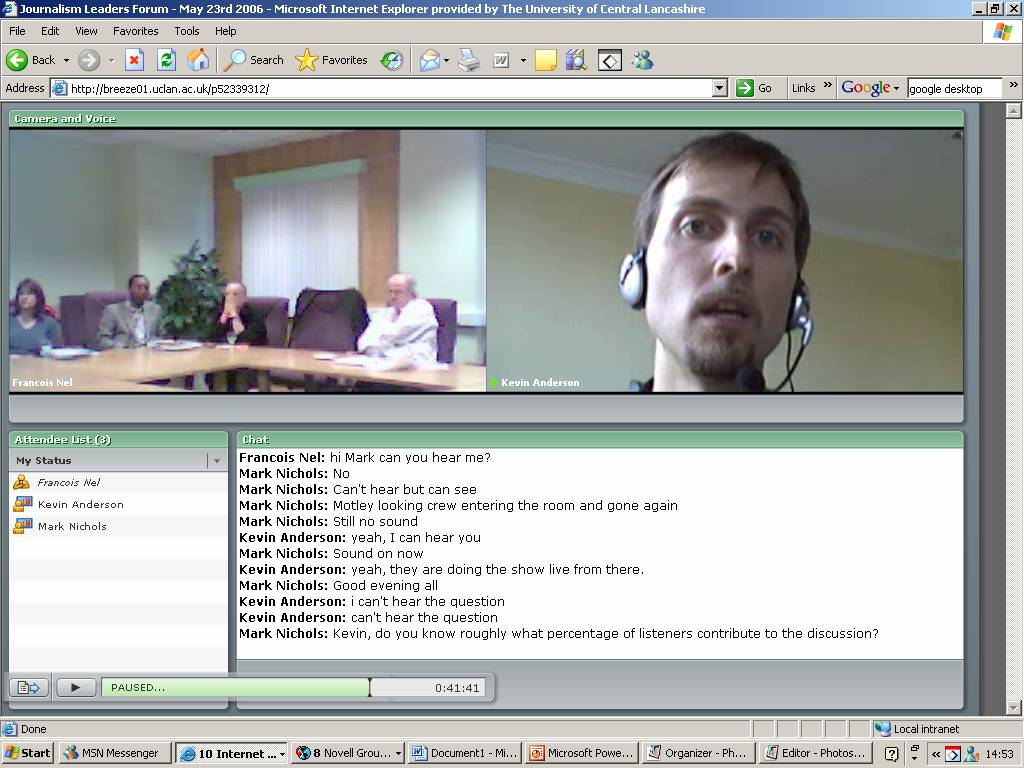
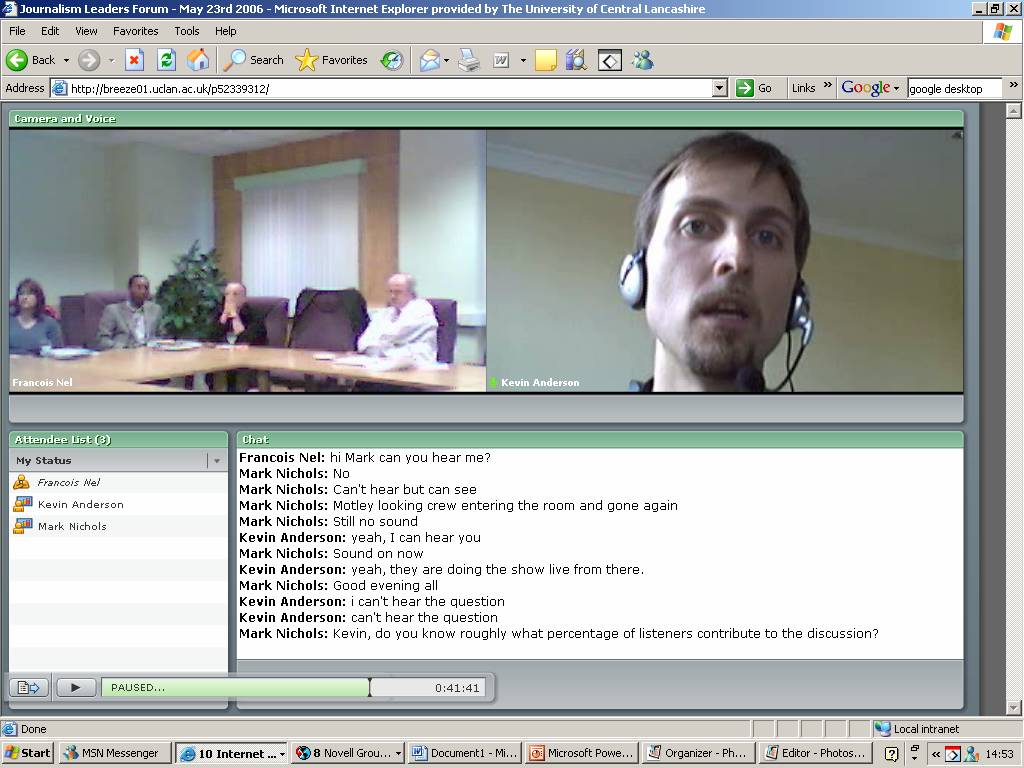
If you missed last night’s Journalism Leaders Forum roundtable on “news as conversation” with Kevin Anderson, the BBC’s 2004 US election blogger who is now on the "World Have Your Say" programme team, it went like this:

Jethro Goko: "I’m glad, Kevin, that you don’t necessarily see a bleak future for print because of blogging. But I do worry about blogging. I can not see a business model for blogging. For me, as long there is no business model and somebody can not make real money, the future looks bleak [for blogging]."

Kevin Anderson: "Well, I think there is two issues and if you are talking strictly about people blogging, there are companies quite happily making money with blog hosting companies. If you are talking about why should you, as a mainstream media outlet, blog. I can give you quite a few compelling reasons...

What I say (and I say this a lot at the BBC) blogs are public interface for a public broadcaster. There is a famous blogger, Robert Scoble, who blogs for Microsoft. And obviously he’s part of their developer network and he says blogging keeps him close to his customer.

For us, blogging keeps us close to our audience. It makes sure that we’re not just off on our own agenda. And I think that is something that we should take on board. That some times there are things our audience wants to hear or talk about, things that aren’t necessarily part of our agenda.

The other thing - and quite honestly it is something that I had an opportunity to do two years ago [when I blogged the 2004 US presidential elections for the BBC] and I haven’t had the opportunity to do, and something I would give my leg for the opportunity to do it-... Blogging is an incredibly powerful news tool.

I can do things, breaking news wise with a blog that I would never be able to do with a newspaper, that I would never be able to do with a radio, that I would never be able to do with television. It’s a missed opportunity. And it enriches our journalism. It returns a responsiveness, it returns a rawness, an immediacy that I think is really somehow missing in our journalism. It is a huge opportunity that is not being met. I think in some ways it’s because a lot of people in the mainstream media don’t understand what blogging actually is or what it represents.

They see it as another opportunity to publish their content. They don’t see it as a way to have a conversation with their audience. Or as a very lightweight powerful tool to publish content from the field and to also take questions from your audience.

Just think if I was on the scene of a breaking story able to publish updates minute by minute that could be pushed out to a network of people who had SMS alerts set up and then they could send me a question and ask me questions directly in the field. That is a powerful relationship with your audience that will make money, that will keep your brand relevant. It is something the mainstream media is not doing. And, quite frankly, it’s a failure on our part."

You can view an unedited recording of the lively discussion here.

Mark your diary, the next forum is scheduled for the week of October 16th. If you want to receive an invitation or e-mail alert, send a note to leadersatukjournalism.org.

We’re still accepting applications to the Principles of Journalism Leadership module this autumn. Check out the participant reviews here - and if you want to join in, you'll find out how on our website.

Monday, May 08, 2006

The Challenge: Make News Conversations Happen

It’s one thing to acknowledge that active, connected information consumers are challenging traditional journalism models by demanding that the news be a conversation not a lecture. It’s quite another to translate that into a regular, viable news product.

That’s exactly what the BBC World Service set out to do with ‘World Have Your Say’ which engages in a ‘global conversation’ every night on the radio between 1800-1900 GMT and 24 hours a day via their website.

Online specialist Kevin Anderson, a key member of the programme team (and contributor to Corante) , will discuss the nitty gritty of making the programme happen - and reflect critically on the lessons learned to date - during the third Journalism Leaders’ Forum at the University of Central Lancashire on May 23rd .

The roundtable discussion chaired by Mike Ward, author of Journalism Online and head of the Department of Journalism at UCLan, forms part of the residential week programme for participants in UCLan’s Journalism Leaders Programme. View the Webcast live from 6pm BST here and join the online chat.

For more information about the Journalism Leaders Programme, read what the participants have had to say or contact the course leader François Nel by email or Skype (francoisnel).

Wednesday, February 01, 2006

Watch it again: forum webcast recording available

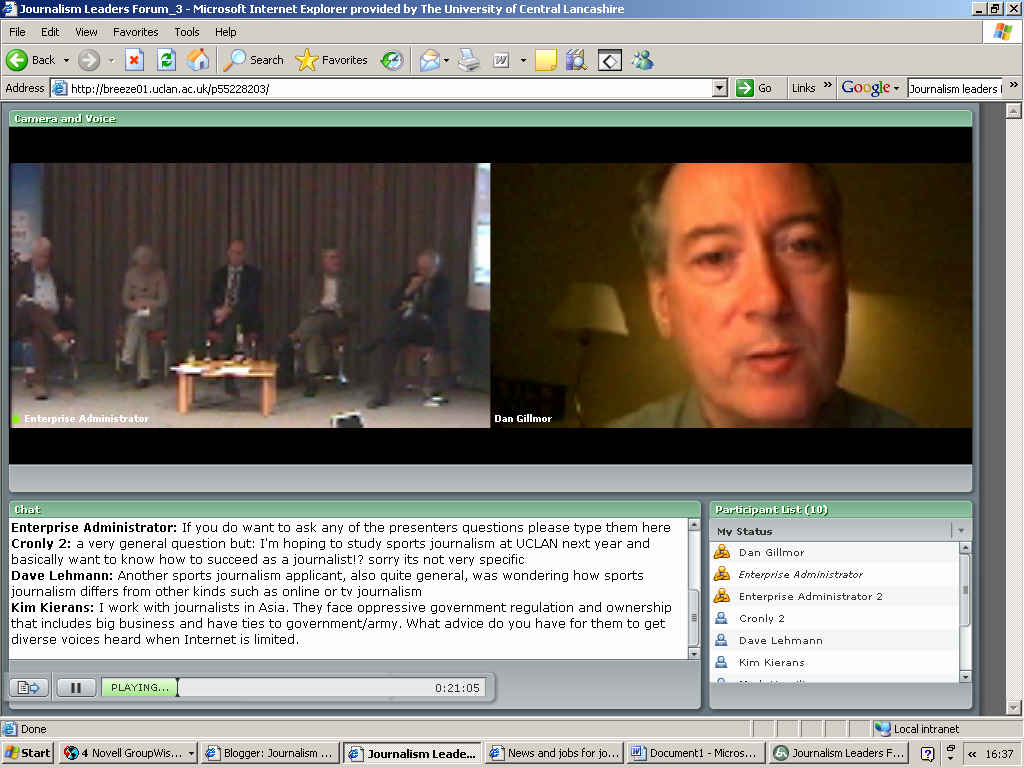
Missed the discussion with Dan Gillmor, Pete Clifton, Cath Hearne, John Fray and Mike Ward on the impact of citizen journalism on the media establishment? Or want to watch it again?

An (unedited) recording of the Journalism Leaders Forum webcast is available HERE.

Of course, we’d welcome your feedback and suggestions for the next forum, which is scheduled for 6:30pm GMT on Tuesday, 23 May 2006, in the same space.

Let's keep the conversation going.

Also read:

Wednesday, January 18, 2006

The implications of Citizen Journalism for the Media Establishment


In a digital environment, where news consumers can also be news producers, how should traditional news media respond? Is citizen journalism a threat or an opportunity?

The second Journalism Leaders’ Forum at the University of Central Lancashire on January 31st will bring together exponents of traditional and new media to debate these questions.

Dan Gillmor is author of We the Media. A former US newspaperman, he is one of the web’s leading advocates of grassroots journalism.
Pete Clifton is Editor of BBC News Interactive, responsible for one of the web’s most successful news sites.
Cath Hearne is editor of BBC London’s nightly news programme and was at the helm on July 7th, a day in which some of the most vivid images of the London bombings were contributed by members of the public.
John Fray is Deputy General Secretary of the National Union of Journalists, which represents 35000 journalists in the UK and Ireland.
And Mike Ward is author of Journalism Online and head of the journalism department at UCLAN.

The debate will be chaired by Nigel Kay, former Head of Journalism Development at the BBC and now an Industrial Fellow at UCLAN. “Traditional journalism stands at the threshold of the digital age, uncertain about what lies ahead,” says Kay. “This discussion will tackle some of those concerns and seek to identify the opportunities.”

The event, which forms part of the residential week programme for participants in the Department of Journalism's new Journalism Leaders Programme, is open to all - practitioners, academics, would-be journalists and others who are interested in the challenges journalists face.

To attend this free programme at 6:30pm on Tuesday, 31st January, in Greenbank Lecture Theatre in Preston - as well as the reception from 5:45pm - please RSVP to FPNel@uclan.ac.uk .

If you can't be there in person, there are other ways to join the discussion. You can post your questions and comments on this site, or you can view the live Webcast by logging in as a guest at: http://breeze01.uclan.ac.uk/r81768061/.

Better still, do both. And let's get the discussion going.

Wednesday, November 02, 2005

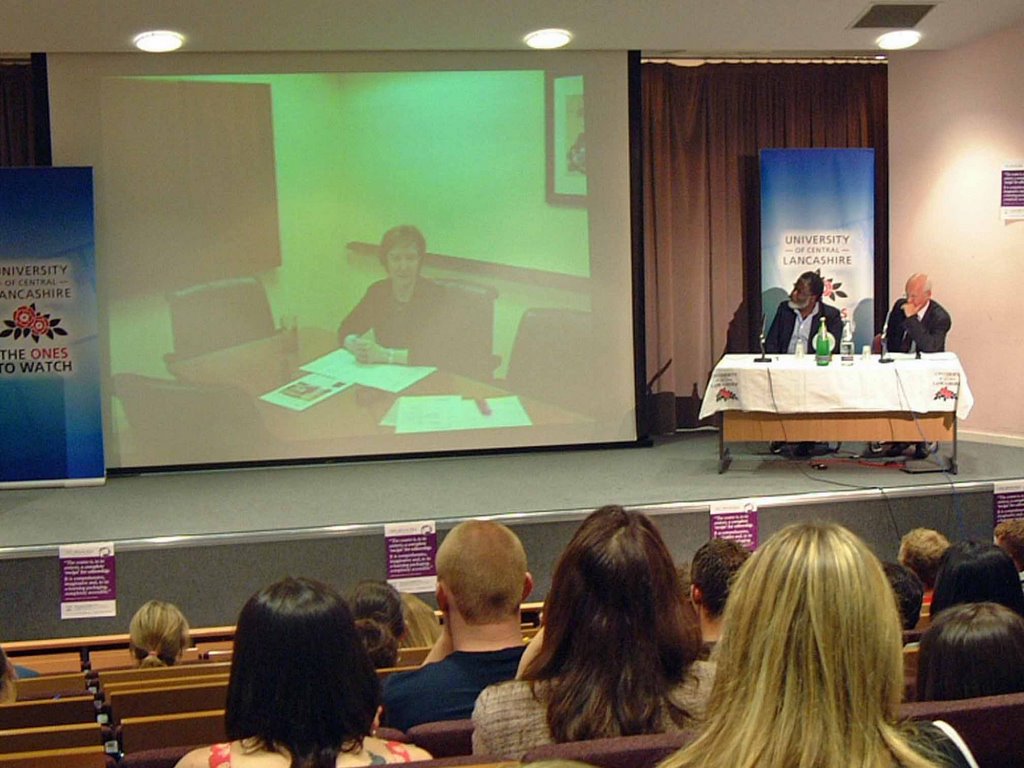
Diverse panel and audience agree: 'It's still about the audience'

The panellists and the audience of the inaugural Journalism Leaders Forum could not have been much more diverse.

But they all agreed on one point.

Perhaps the greatest question journalism leaders should be asking in the 21st Century is simply this: How are audiences best served?

That should still be the key concern whether journalism leaders are tackling the challenges of reporting and disseminating news under an oppressive political regime, such as Wilf Mbanga of The Zimbabwean is. Or straining under the relentless demands of profit-hungry shareholders, which pressurises regional newspaper editors such as UK Society President Keith Sutton. Or grappling with the uncertainties of making journalism in a context of technological-savvy audiences, which concerns Mary Glick and others at the American Press Institute in Virginia, UK.

You can watch an edited version of the lively discussion here.

Want to know even more? Check out Journalism Leaders Programme course leader François Nel’s in-depth interview with Wilf Mbanga. The first in a series of 'Conversations with Journalism Leaders' is available for viewing* here [recommended for broadband connections] and here [recommended for dial-up connections].

Amongst the questions Mbanga answers is this: Why, as the then-head of the Zimbabwe International News Agency, did he not report on the 1980s massacre of tens of thousands of civilians by President Robert Mugabe's North Korean-trained Fifth Brigade?

Of course, don’t hesitate to post your comments on this blog, too.

Mark your calendar : The next Journalism Leaders Forum at 6:30pm GMT on Tuesday, 31 January 2006, will be chaired by Nigel Kay, who has been a BBC journalist for more than 30 years. When he left the corporation in October 2005 he was the professional line manager for 3000 television, radio and online journalists working in the BBC’s Nations and Regions. We hope you can join us in Preston, or online.

* These videos require RealPlayer software, which can be downloaded for free here.

Wednesday, August 10, 2005

Which questions should we be asking?

There has been much talk of late about crises in the media. Crises of trust. Crises of competence. Crises of confidence. And, as may be expected, there has also been a great deal said about what the solutions are.

But, perhaps, those concerned about the state and future of journalism would do well to pause and consider the advice of management sage Peter Drucker: In the 20th century, great leaders gave great answers. In the 21st century, however, great leaders will ask great questions.

If that is so, what are the great questions that journalism leaders should be asking?

That is the question we will explore during the first Journalism Leaders Forum, 7-9pm British Summer Time (GMT+1) on Tuesday, 11 October 2005, in Greenbank Auditorium, Lancashire Business School, University of Central Lancashire, Preston, UK.

Keith Sutton (far left), president of the UK Society of Editors, Mary Glick, associate director of the American Press Institute, and Wilf Mbanga (above right), editor of The Zimbabwean, are amongst those on the panel. François Nel, course leader for the Journalism Leaders Programme, will chair the session.

To attend this free programme on the day - as well as the reception from 6:30p - please RSVP to leaders@ukjournalism.org . If you can't be there in person, there are other ways to join the discussion. You can post your questions and comments on this site, or you can view the live Webcast at: http://breeze01.uclan.ac.uk/r81768061/.

Better still, do both. And let's get the discussion going.